
A material built from different ingredients
A composite combines materials that retain their identities within the finished structure. The combination has properties different from those of its ingredients. The Wikipedia composite-material reference explains the distinction between reinforcement, which contributes mechanical properties, and a matrix, which surrounds it and holds it in position. In fiber-reinforced plastics, that matrix is a polymer. The reinforcement can be glass or carbon fiber, among other materials. A technician therefore needs to understand both the fiber and the material binding it.
The appeal is the ability to combine strength, stiffness and relatively low weight for a particular application. Fiber-reinforced plastics appear in marine structures, aircraft components, vehicles and construction. The final part's behavior depends on more than the name of its fiber. The resin, the fiber arrangement, the manufacturing process and the shape all contribute. A woven fabric and a stack of aligned layers are different ways to distribute reinforcement. A laminate is a structure built from distinct layers.
Glass, carbon and resin
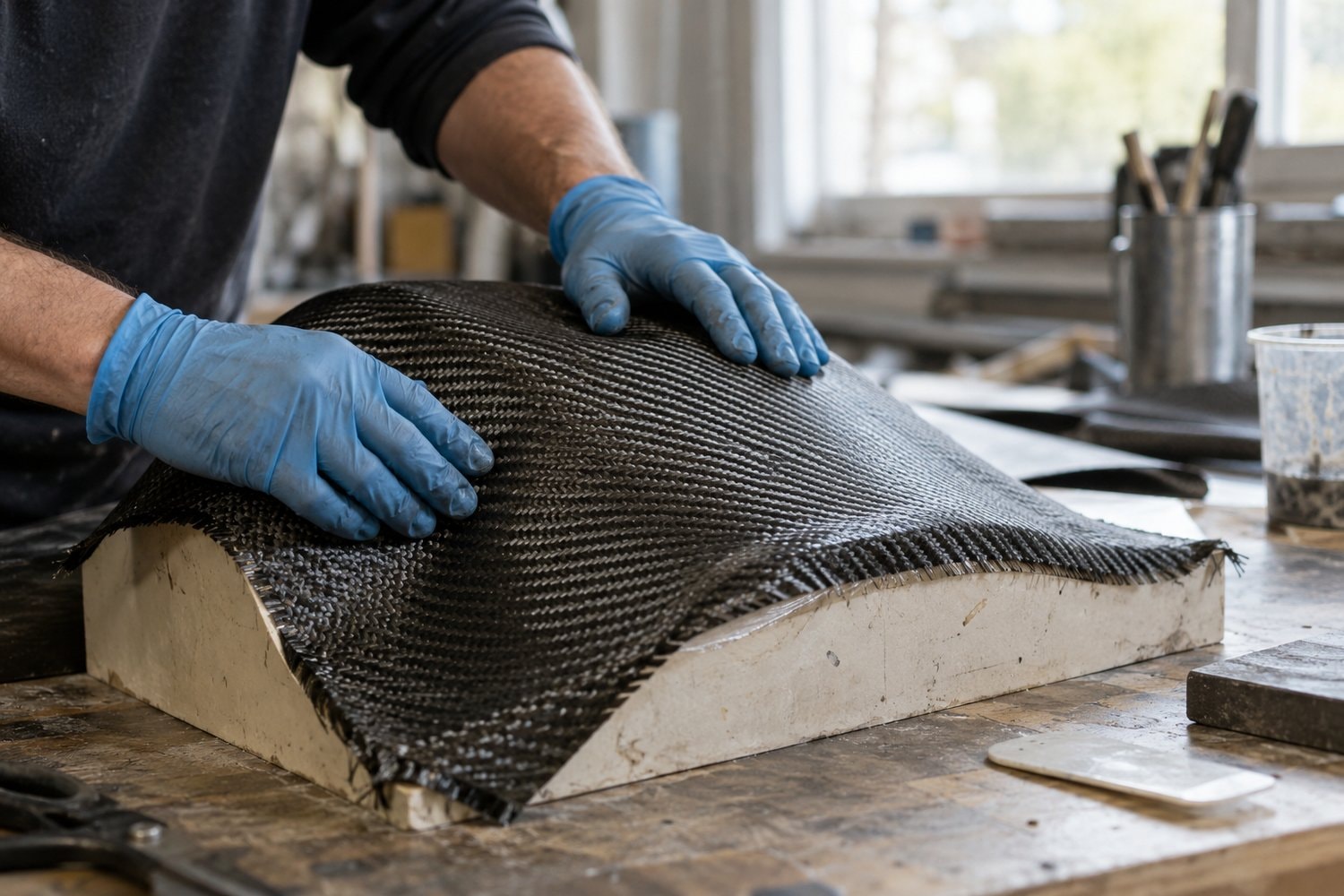
Fiberglass uses glass reinforcement within a plastic matrix. The glass can be woven into cloth or supplied as a mat of short fibers. Its ability to take complex molded shapes helps explain its use in hulls, tanks and panels. Carbon-fiber-reinforced polymer is valued where stiffness and strength relative to weight matter. Its properties depend on fiber layout and on how much fiber is present relative to the polymer. A dark woven surface alone does not describe the internal structure or establish a part's performance.
Epoxy is a family of reactive resins and their cured products. Curing produces a cross-linked polymer network, often through a reaction with a hardener. The matrix binds the reinforcement into a usable part. The epoxy reference identifies contact dermatitis, allergic reactions and respiratory problems associated with resin compounds, vapor and sanding dust, especially from incompletely cured material. Pre-preg arrives with resin already distributed through the fibers; in thermoset pre-preg, the matrix is partly cured before final processing. That material state affects storage and manufacturing requirements. The separate carbon fiber account follows the distinction between a precursor, a loose filament, a fabric and a finished polymer composite.
Fabrication, assembly and inspection
Fabrication concerns the material and geometry of the part. Assembly concerns how parts join into a larger structure. The NSC learning outcomes covered selection of materials and processes, interpretation of drawings, fastening, tooling, inspection and technical documentation. These topics connect practical shop work to the specification governing the finished item. Precision applies to positioning a fitting or interpreting a print as well as to measuring a machined surface.
O*NET's laminator description makes that connection concrete. The occupation includes arranging glass reinforcement on molds, using resin systems, trimming excess material, and checking finished products against specifications. Its listed checks include visual examination and measurements with rulers or micrometers. The occupational description also includes modifications to damaged fiberglass parts. These are descriptions of trained production work; they are not a substitute for a process specification or supervised instruction.
Repair begins with the structure
Damage in a laminate can extend beneath an apparently small surface mark. The composite-repair reference distinguishes laminated structures from sandwich panels, whose skins surround a lightweight core. Impact can produce different damage patterns in those structures. Surface appearance is therefore an incomplete basis for judging a structural component. The reference describes nondestructive inspection as part of determining the extent of damage.
Material compatibility, service conditions, access to the damaged area and the structure's design requirements shape a repair decision. Quality checks examine the repaired region and its connection to the surrounding material. This is why repair was a distinct topic in the composites curriculum rather than simply another name for fabrication. Understanding fiber direction, the matrix and the structure remains relevant after a component has left the mold.
CNC machining, tooling and molding
CNC means computer numerical control: a computer directs a machine tool through a programmed sequence. It connects a part's design and dimensions to controlled tool motion. Machining can produce the tooling and fixtures associated with composite production as well as finished components. A mold establishes a part's shape; an injection-molding process introduces material into a mold cavity, where it takes that form. Tool geometry, material properties and the desired features of the part all enter the design.
O*NET describes machinists as setting up machine tools and producing precision parts. Their tasks include interpreting engineering information, calculating dimensions and tolerances, programming controlled equipment, and inspecting output. Tool and die makers focus on dies, jigs, fixtures, gauges and related tools, with attention to fit and clearances. Team assemblers rotate among production tasks, check quality and record production information. These occupations describe distinct responsibilities rather than interchangeable job titles. The mechatronics field provides another view of the electrical, mechanical and control systems behind automated equipment.
Chemical information and workplace protection
OSHA's Hazard Communication overview says chemical identities and hazards must be understandable to workers. Employers with hazardous chemicals must provide labels and safety data sheets and train exposed workers. Resin systems and other production chemicals belong within that organized workplace approach. Reading a materials description cannot establish which controls a particular workplace or substance requires.
OSHA's protective-equipment guidance describes employer responsibilities for selection, use and worker training, including the limits of the equipment. Protection is part of a workplace program addressing the hazards present. The technician's body at work discusses physical exposures across technical jobs. For a broader comparison of tasks and settings, the fields side by side places composite production alongside support, vehicle, environmental and automation work.