
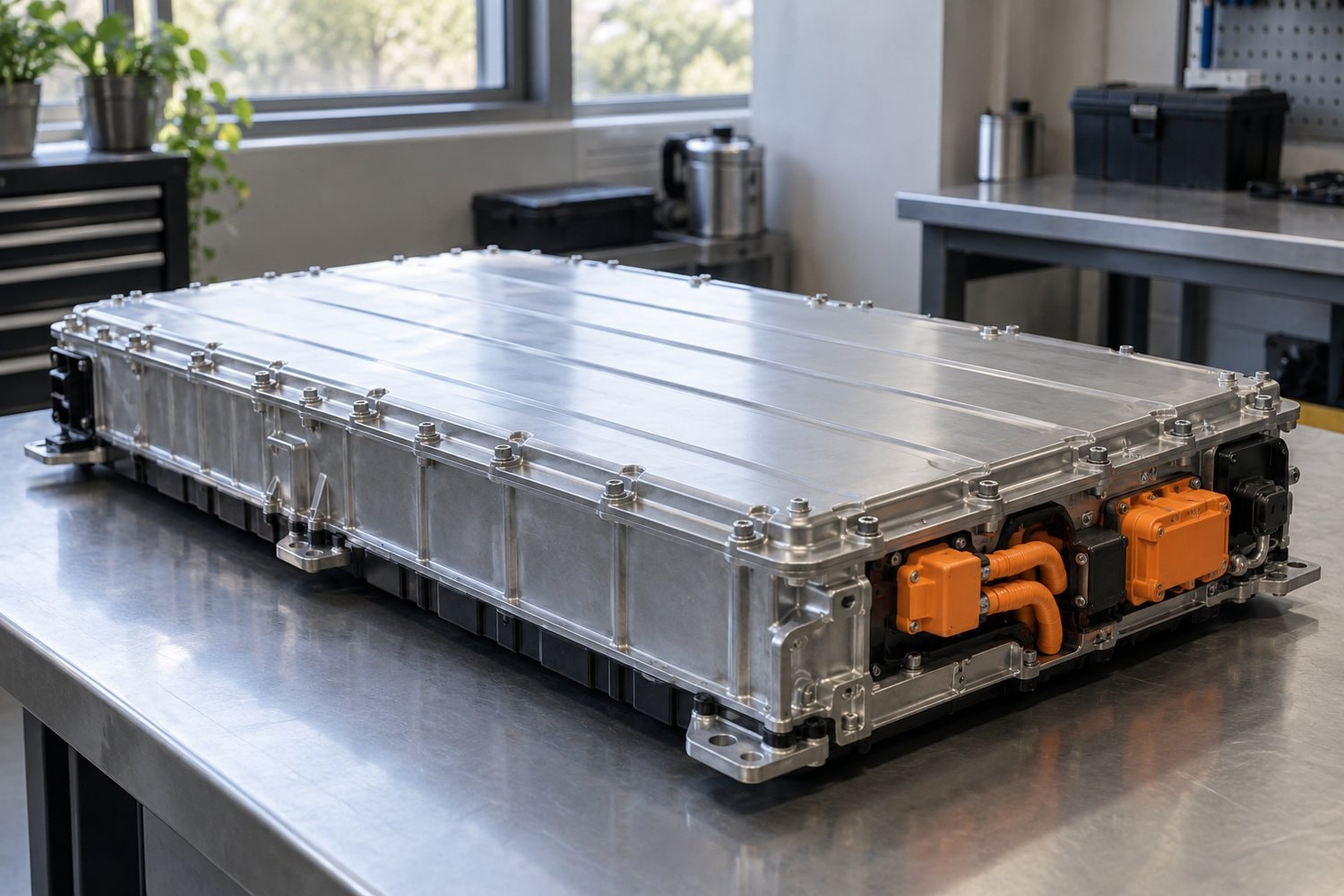
A pack is a vehicle energy system
A traction battery supplies electrical energy for propulsion. The electric-vehicle battery reference describes rechargeable batteries powering motors in battery-electric and hybrid vehicles. The pack is more than the electrochemical material: its cells, electrical connections, structural arrangement and monitoring form an integrated vehicle system. Chemistry describes a cell's materials; pack design describes how those cells serve an application.
Cells may have different shapes and sizes. Their connections combine them to meet the pack's voltage and current requirements. Series connections and parallel connections serve different electrical purposes within that arrangement. Modules group cells into assemblies that help organize manufacture and integration. Modules can then form a pack, although the reference also describes cell-to-pack construction without the intervening module arrangement. The familiar cell, module and pack hierarchy is therefore a useful outline rather than a universal layout.
What happens within a lithium-ion cell
The lithium-ion battery reference describes rechargeable cells that store energy through the reversible movement of lithium ions into electrode materials. A cell includes electrodes, electrolyte, a separator, current collectors and a casing. The electrolyte allows ions to move inside the cell, while electrons travel through the external circuit. The separator keeps the electrodes from directly shorting against each other.
During discharge, chemical reactions supply energy to that circuit. During charging, an external source supplies energy and reverses the movement and reactions. The negative electrode is commonly graphite; the positive electrode may use a metal oxide or phosphate. Different materials change the cell's voltage, energy density, life and safety characteristics. Lithium-ion is therefore a family of systems rather than a description of an identical material in every vehicle.
Vehicle-battery discussions include lithium nickel manganese cobalt oxides, lithium iron phosphate and lithium nickel cobalt aluminum oxide among the chemistry families. The underlying material choices involve tradeoffs in the properties needed for a particular design. A cell optimized for storing energy and a cell optimized for delivering power describe different priorities. Those priorities connect electrochemistry to the demands of the larger vehicle system.
Monitoring and temperature
The vehicle-battery reference describes modules with temperature monitors and cooling mechanisms. It also identifies battery-management systems that monitor cell voltages within a stack. The monitoring concerns individual elements within the assembly, not just a single value describing the pack as a whole. Elsewhere, the reference discusses information about pack state of health as relevant to evaluating batteries for another use.
Temperature is part of this system context. The lithium-ion reference states that exposure to heat affects battery life and that charging limits differ from operating limits. A material's chemistry and the system around it both matter to performance. This is why a pack cannot be understood simply as a sealed container filled with cells. Its mechanical, electrical and thermal arrangements work together within the application.
Research from materials to modules
The Department of Energy's vehicle-battery account describes research into materials, electrochemical interactions, failure modes and diagnostic techniques. Its applied research concerns performance and life in advanced cells, while development and testing address robust cells and modules for particular vehicle applications. The account names power, energy, durability and tolerance of abuse conditions among the performance questions.
These distinctions help separate levels of technical work. Materials research asks about reactions and component choices. Cell research examines how those choices behave in an electrochemical unit. Module development and system testing place units into a larger assembly. The electric vehicle technology account puts battery knowledge alongside motors, power electronics, vehicle controls and service tasks.
How a starter battery differs
The automotive-battery reference describes conventional lead-acid starter batteries supplying a nominal 12-volt system in most passenger vehicles and light trucks. Their central task is delivering a brief high current to turn an engine's starter. They also supply accessories and support the vehicle's electrical system. That role differs from supplying propulsion energy across a journey.
The reference states that starter batteries are not designed for deep discharging. It also explains that electric vehicles can have an auxiliary battery for ordinary accessories alongside their traction system. A smaller auxiliary supply and the main propulsion pack therefore have different purposes even when both appear in the same vehicle. The type of battery cannot be inferred solely from the word automotive.
Another use and eventual recycling
The vehicle-battery reference discusses repurposing a pack for stationary storage after its vehicle use. It identifies assessment of remaining performance, different power and energy requirements, and the challenge of disassembling cells and modules as issues for such work. A possible later use is therefore an engineering and evaluation question rather than an automatic next step for every pack.
The same reference describes recycling as the eventual end-of-life route and explains that results vary with chemistry, cell form and recycling process. Material recovery and the energy used by a process both enter that account. A broad claim that all battery recycling has the same environmental result would overlook those distinctions.
Electrical and chemical hazards
The lithium-ion reference identifies fire and explosion hazards associated with flammable electrolytes. Vehicle high-voltage systems are an electrical hazard, and work on them belongs to trained, qualified technicians under appropriate supervision; OSHA's electrical overview describes shock, electrocution, fire and explosion risks and emphasizes employee training. Service work requires training appropriate to the equipment and workplace hazards. The workplace-health account discusses physical exposures in technical work, while mechatronics provides context for related electrical and mechanical systems.