
The filament and the finished material
Carbon fiber can mean a loose reinforcement or, in ordinary usage, a rigid composite containing it. Those are different stages of manufacture. The Wikipedia carbon-fibers reference describes filaments composed mainly of carbon atoms. It lists stiffness, tensile strength, chemical resistance, temperature tolerance and low thermal expansion among their properties. A filament still needs an appropriate surrounding material and arrangement to become a finished structural part.
A precursor is the starting material from which the filament is made. The reference identifies polyacrylonitrile, often abbreviated PAN, along with rayon and pitch as precursors. Their compositions and processing routes affect the resulting fiber. Making carbon fiber is therefore a material transformation, not simply cutting a sheet of dark fabric. Fabric construction happens after the underlying filament has acquired its properties.
From precursor to continuous fiber
In the manufacture described by the reference, polymer precursors such as PAN and rayon are spun into filament yarns. Chemical and mechanical processes help align their molecules. Drawing and spinning influence the final physical properties. Heating then removes non-carbon atoms in a process called carbonization. Additional treatment can affect handling qualities before the fiber is wound onto bobbins. The precursor and processing history both matter to the finished reinforcement.
The reference's PAN example includes oxidative treatment followed by heating in an inert atmosphere. It explains that the treatment conditions and tension affect the developing structure and properties. Further heat treatment can change the balance between tensile strength and stiffness. This outline describes industrial production; it does not provide manufacturing settings or a procedure for reproducing it.
Carbon atoms form sheets within the filament, but their organization is not identical across all carbon fibers. The reference distinguishes more ordered graphitic structures from turbostratic structures, whose sheets are less regularly arranged. It connects PAN-derived fibers with the latter and heat-treated pitch-derived fibers with the former. This is another reason that a common material name does not imply identical mechanical or thermal behavior.
Yarn, tow and fabric
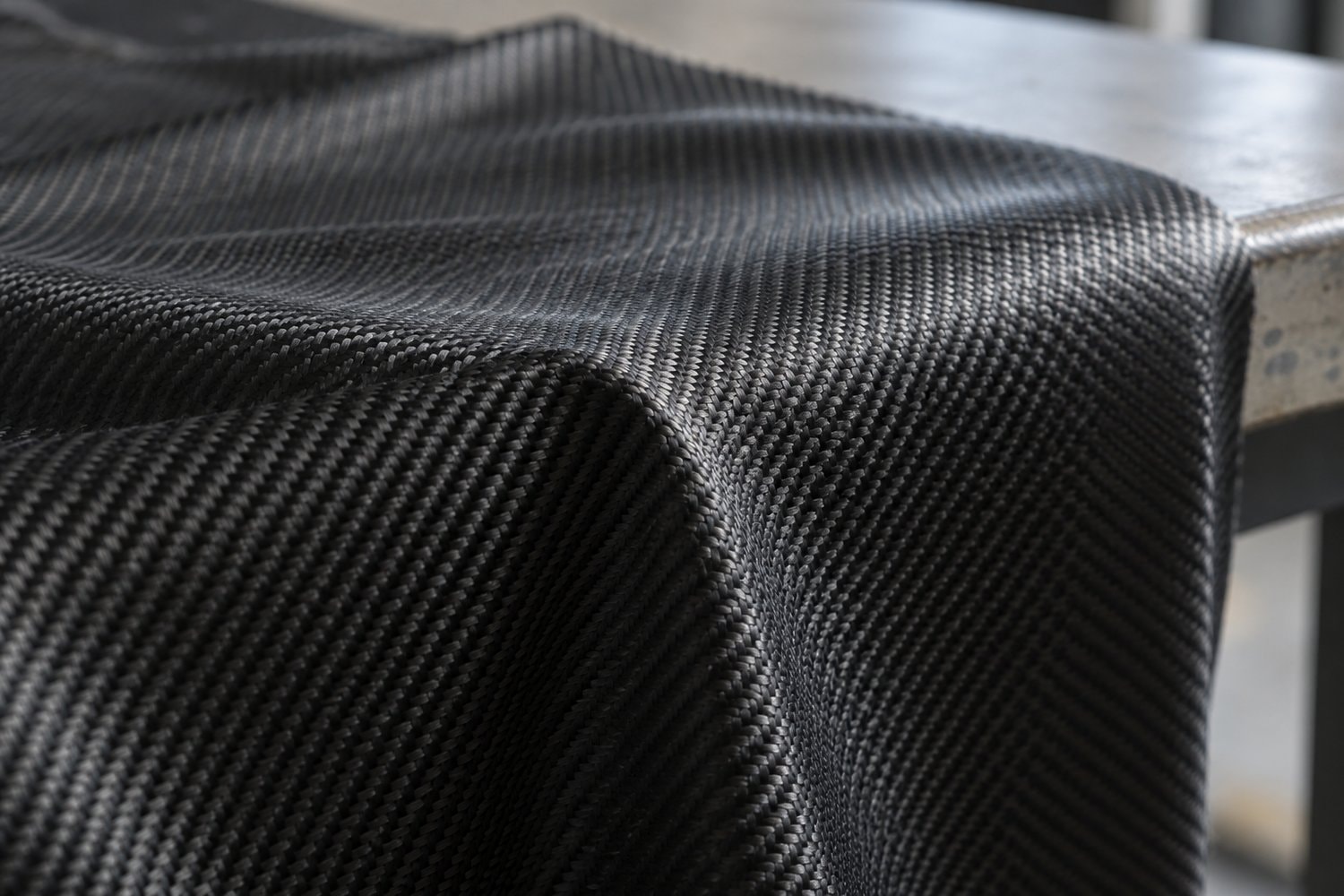
A tow is a bundle of continuous filaments. A coating, also called sizing, holds and protects those filaments during handling. Tow can be supplied on a reel and used in processes such as filament winding or in textile manufacture. Carbon yarn can become woven cloth, knitted material or a braided structure. Plain, twill and satin describe weave forms, rather than different chemical kinds of carbon.
Reinforcement can also be arranged in aligned layers. Fiber direction affects the stiffness and strength of a finished part because the reinforcement carries loads differently along and across its arrangement. The visible weave is only part of that story. A technician interpreting drawings or material specifications needs to distinguish the form of the incoming reinforcement from the layout of the complete laminate.
Carbon-fiber-reinforced polymer
The carbon-fiber-reinforced polymer reference describes a composite with carbon reinforcement bound by a polymer matrix. Epoxy is common, but other thermoset and thermoplastic matrices are possible. The fiber contributes strength and rigidity; the matrix holds the reinforcement together. Fiber layout and the proportion of reinforcement relative to matrix affect the finished material's properties.
This composite is used where stiffness and strength relative to weight matter, including aerospace structures, ships, vehicles, civil engineering and sporting equipment. Its directional properties distinguish it from materials with more uniform behavior in every direction. A laminate's design determines how its layers respond to the anticipated loads. The broad composites technology account connects that material knowledge to fabrication, assembly, machining and inspection.
Pre-preg and curing
Wikipedia's pre-preg reference describes fibers already impregnated with a polymer matrix. In thermoset pre-preg, that matrix is partly cured, allowing the material to be handled before final curing. The reference describes cooled storage and the use of ovens or autoclaves in completing the cure. These are characteristics of a controlled material system, whose storage and processing requirements belong to trained manufacturing work.
Epoxy curing creates cross-links in the polymer. A hardener is a reacting component, not merely a liquid that evaporates from the finished part. The resin and reinforcement become a composite structure while retaining their distinct material roles. Resin choice affects properties such as resistance to heat and chemicals. The epoxy reference also identifies exposure hazards associated with resin compounds and dust from incompletely cured material; those belong within workplace chemical-hazard controls.
Comparing glass and carbon reinforcement
The fiberglass reference describes glass-reinforced plastic as cheaper and more flexible than carbon fiber. Glass reinforcement can take the form of woven cloth or chopped mats, and fiberglass can form complex molded shapes. Carbon reinforcement is associated with high stiffness and strength relative to weight. The comparison concerns material choices rather than a universal ranking of which composite is best.
Both systems depend on the matrix and the arrangement of fibers. Glass fibers constrained in a chosen direction produce different behavior from randomly oriented reinforcement; carbon laminates also have directional properties. Material selection therefore connects an application's shape and loading to its reinforcement and manufacturing route. The field comparison places this work among other technician activities, while working safely adds the physical-work context of workshops and field settings.