
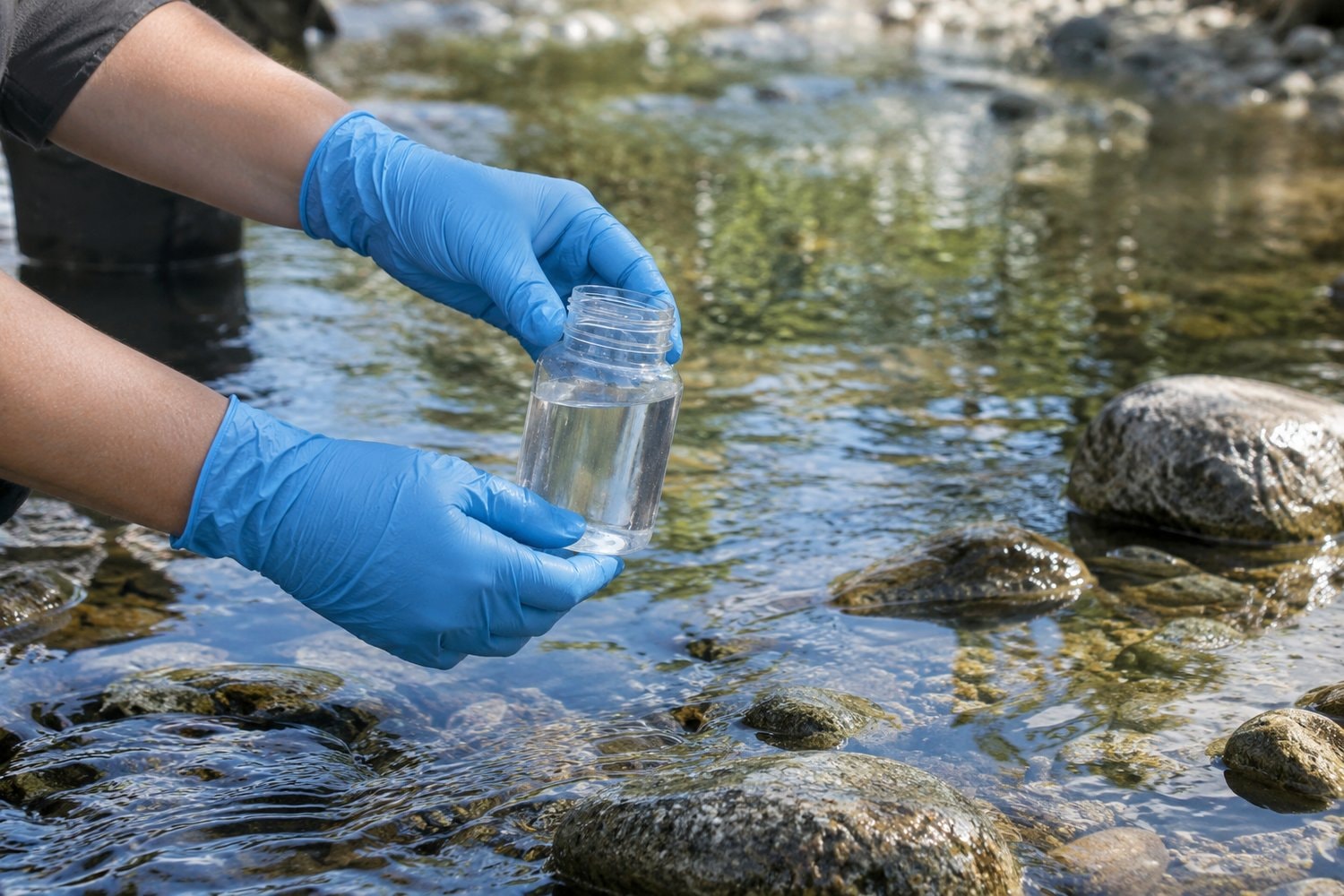
Quality depends on the intended use
The U.S. Geological Survey's Water Science School overview describes water quality in terms of physical, chemical and biological characteristics and whether water is suitable for a particular use. Water intended for drinking, for an industrial process or for a river habitat is evaluated against different needs. Appearance alone cannot answer that question. A clear sample may still require chemical or biological analysis, while suspended material can matter in different ways for different uses.
This makes water-quality monitoring a question of evidence and purpose. Environmental monitoring programs establish a condition or baseline and look for change. A water-quality investigation has to connect the place and time of a measurement with the condition it is intended to describe. The broader environmental technology field includes this work alongside air monitoring, waste management and workplace exposure questions.
What gets measured
Common measurements listed in the water-quality reference include temperature, pH, dissolved oxygen, conductivity and turbidity. Some are made in direct contact with the water at a sampling location. Others require a sample to be analyzed in a laboratory. The USGS topic collection also identifies hardness, alkalinity, biochemical oxygen demand, nitrogen and phosphorus as water-quality subjects. Biological questions can include bacteria and the organisms present in a water body. These names describe different properties, rather than interchangeable readings from the same test.
The distinction between field and laboratory measurements matters because a sample does not remain entirely unchanged when it leaves its source. Temperature can change, suspended particles can settle, and contact with a container can affect the substances being measured. Water chemistry can respond to its new surroundings. The water-quality reference discusses these as reasons that sampling and analysis require planned methods. A general account can explain the problem without providing instructions for collecting, preserving or chemically handling a sample.
Representativeness is another issue. A reading describes the sampled water at a particular place and time. Conditions can vary with season, time of day, location and rainfall. A brief pollution event may be missed by an isolated sample. Continuous monitoring and repeated sampling address different questions from a single sample. Understanding what the investigation seeks to measure is therefore part of understanding its result: a comparison is meaningful only when the measurements describe the relevant conditions.
Monitoring at a national scale
USGS describes its National Water Quality Program as examining water-quality conditions, change over time and the influence of natural features and human activities. That perspective connects local measurements to broader questions. A river or groundwater result can be interpreted alongside information about geography, land use and trends. Monitoring can describe a condition even when it is not part of a drinking-water compliance test.
EPA's water-quality data overview describes information gathered by government agencies, Tribal programs, local organizations and other groups. The Water Quality eXchange supplies a shared format and mechanism for exchanging monitoring data. The Water Quality Portal combines submitted information with USGS data for public retrieval. EPA explains that the resulting information helps water-resource managers identify pollution problems, direct control efforts and examine progress. Shared data depend on records that make the measurement useful beyond the team that collected it.
Drinking water and surface-water standards
The EPA Safe Drinking Water Act overview describes the law as regulating the nation's public drinking-water supply. Its resources distinguish primary drinking-water regulations, secondary regulations, analytical methods and annual water-quality reports. EPA's ground-water and drinking-water collection also includes laboratory certification, source-water protection and distribution systems. Public drinking-water regulation has a particular purpose; it is not a general approval of every possible use of a river, lake or well.
EPA's water-quality standards overview addresses lakes, rivers, estuaries and other water bodies used for activities such as fishing and swimming. States and authorized Tribes develop standards relevant to local conditions. EPA reviews and approves them under the Clean Water Act before their use for purposes including discharge permitting and water-body assessment. Criteria describe pollutant levels or conditions associated with water-body uses. That connection between a use and a criterion explains why a measured concentration needs regulatory and environmental context.
Wastewater treatment as a system
Wastewater treatment uses physical separation, biological processes and chemical processes to remove contaminants. Municipal sewage and industrial wastewater can require different facilities or pretreatment arrangements. Settling separates materials by phase; biological processes address organic material; further processes can be used to meet the intended effluent quality. Sludge is a by-product that also has to be managed. Treatment choices depend on the contamination and on the planned discharge or reuse of the water.
O*NET's treatment-plant operator profile describes operating or controlling a process or system that transfers or processes water or wastewater. Duties include testing samples, observing meters and gauges, recording operating data and inspecting equipment. Operators also maintain logs and discharge-monitoring reports. The occupation combines measurement with attention to an operating system: a test result, an equipment condition and a record of a change can all be part of the same working situation.
Control boards and operating equipment connect water systems to subjects covered in programmable logic controllers, sensors and actuators. The connection is conceptual: monitoring supplies information, while a treatment operation also uses equipment to affect the process. Occupational descriptions identify responsibilities rather than qualifying a reader to perform them. The distinction helps a learner compare environmental sampling, laboratory analysis and plant operation without treating those roles as identical.